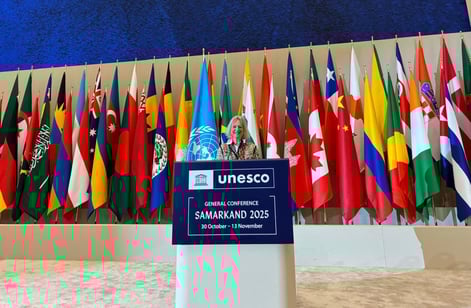
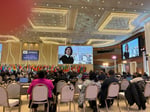
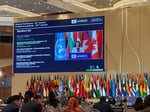
The Venue – The 43rd session of UNESCO General Conference (30 oct to 13 Nov 2025) was held in two different areas outside the city of Samarkand (Uzbekistan), one for plenaries and thematic sessions with Member States’Delegations and seats reserved for NGOs at the back of the large room and another area – Expo Congress and Expo Center for UNESCO exhibition « Sharing Humanity since 1945 » and for UNESCO Commissions Meetings, open working spaces and beverages (water, tea, coffee), printers and information desk, a UNESCO boutique and a small room named « NGO Space » to hold the events planned by the Secretariat of Civil Society Partnerships and the NGO-UNESCO Liaison Committee. The two areas were quite at a distance and going from one place to another made it difficult to attend simultaneous meetings, as there were also security checkings.
CSOs Participation -Less than 20 (NGOs & Foundations including NGO-UNESCO Liaison Committee members. ACWW; BPW International; IAU; IAUPL; ICFT; IEA; IMC; FIAPA; FMPS (LC foundation); FMTS; IFLA; IFOR; OMEP; SAF ; UEA (Esperanto);VSO ;WASME;
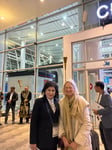
A Warm Welcome by Uzbekistan :We were warmly welcomed at Samarkand airport by young student volunteers who were attributed by the Uzbekistan Government to some participants and delegations including me as Head of IFBPW Delegation with the special support of Dr Nurmatova Mukarram Akhmedovna, Deputy Chairperson of the Committee on Family and Women of the republic of Uzbekistan.
This precious support ensured fluid transition between the sessions and facilitation of official invitations to side events and receptions, throughout the General Conference up to the departure. I thanked Uzbekistan for the warm welcome and for the volunteers’ support and DG Audrey Azoulay for her strong leadership including on Gender Equality , before reading. BPW International statement addressed to the General Conference participants during the General Political Debate, on 5th November in the Plenary.
Diplomacy: I was invited by Dr Nurmatova Mukarram Akhmedovna to attend the official opening of the Conference by the President of Uzbekistan, and met with the representative of UN WOMEN in Central Asia and from Uzbekistan who gave me her card that I shared with BPW International President and Office for connexion and cooperation.
Dr Mukarram also facilitated my invitation to the first evening reception with music and traditional food and to the official reception after the side event on Women in Science where I had the pleasure to speak with the Uzbekistan Minister of Family and Women, UNESCO DG Audrey Azoulay before the end of her mandate, in the presence of the new UNESCO DG, of the President
of the 42nd General Conference and the Director of Gender Equality and her team as well as delegations from Scandinavia. I was also invited to dance like other distinguished participants with the traditional dancers to the enchanting sound of Uzbekistan music.
Opportunities for Advocacy and lobbying : Besides the 3mns statement made in the General Political Debate on behalf of the International Federation of Business &
Professional Women as Observer, I took the floor twice in the NGO Space; first on the “Cooperation between NGOs and the National Commissions to UNESCO” with BPW International participation as co-organizer and moderator of the last two events to celebrate the ID of Peace by a collective group of NGOs in official partnership with UNESCO , under the patronage of the French National Commission in 2024 at UNESCO headquarters-Sharing Dance for Peace- and in the regional Bureau of UNESCO for the Maghreb in Rabat, 7 September 2025 – The role of Art in the Culture of Peace.
This was also an opportunity to connect with the SG of the UK National Commission to UNESCO and speak about the role of BPW UK in supporting Ukraine, as well as mention our role in the collective group called Voix des Filles to celebrate the ID of Girls’Rights, in francophone Africa (with BPW Senegal).
I also seized the second opportunity to present IFBPW actions and strategy for 2026, in the same NGO Space, in another slot entitled “Focus NGOs -Sharing experiences”.
The Education Commission was of particular interest and another opportunity to advocate and lobby with delegations- Belgium, France, the European Foreign Affairs, the Netherlands, Denmark, Sweden, South Korea, inter alia , and the Education Sector for sharing our recommendations on SDG4, for Gender Equality and Peace and UNESCO human centered approach.
Outcomes and Resolutions: ILO/UNESCO Recommendation concerning the Status of Teachers (1966) and the UNESCO Recommendation concerning the Status of Higher-Education Teaching Personnel (1997) were amended & adopted for a better protection of the rights and academic freedom of teachers and researchers and gender equality and equity.
Context: The revision was proposed in face of Gender Equality issues persisting and requiring additional attention with fewer Female educators represented in secondary and tertiary education than at early childhood and primary education, besides the lack of female teachers in TVET and STEM, and gender imbalances in senior and leadership positions and pay gaps between female and male academics that persist in all regions. It was a hard fight to keep equal besides equitable but thanks to lobbying it was a win.
Although the 1966 Recommendation addressed gender to some extent by reference to female teachers, the language of the text was not always adequately sensitive to gender. Moreover, issues such as pay equity, equitable career advancement and access to care services were not featured prominently enough to promote gender equality within the teaching workforce (paragraphs 54-58).13.The 1966 Recommendation did not substantially address issues related to equity and inclusion. The reformed pedagogical training is needed to address systemic and attitudinal forms of discrimination, so that teachers are prepared to deliver an inclusive, learner-centred and gender-transformative pedagogy. The 1966 Recommendation broadly addresses issues relating to modern teaching, teaching methods, research and information resources, and international exchange of information but lacks references to new digital technologies, information and communication technology, open and distance learning, as well as artificial intelligence. Leveraging new digital technologies, empowering teachers with training and giving them an opportunity to contribut to decision-making on questions related to digital transformation in education needed being addressed.
A resolution to support educational and humanistic actions of UNRWA in Palestine and the Middle East was adopted almost by consensus except for two oppositions ( Panama
& Argentina).
The Ethics of Neurotechnology was adopted on 5th November, after the adoption on the Ethics of AI in 2021, marking the culmination of a broad process launched by DG Audrey Azoulay in 2019. The adoption of this Recommendation is the result of an extensive consultation process launched in 2021, French scientist Hervé Chneiweiss and American professor Nita Farahany, chaired the group of experts and was tasked with developing the normative framework, drawing on more than 8,000 contributions from civil society, the private sector, academia, and Member States.
Conclusions: Globally Delegations were in favour of strengthening UNESCO as a Laboratory of Ideas, commending its role as THE Agency for SDG4 and the Futures of Education, its work on ethics and AI, its focus on multilateralism, the role of culture and Arts (Mondiacult) and for Peace. Despite some criticism on finances and too much spending , most Countries commended the key role of UNESCO with one Delegation ‘s true compliment « No one recovers from UNESCO”.
The ceremony with tributes from the Delegations to Audrey Azoulay for her visionary leadership on culture, on gender equality – Women in Science -and defence of journalists and Peace was very moving.
The show performed by the French musician Jean Michel Jarre, Voluntary Ambassador of UNESCO in front of the Historic Registan , mixing modernism and history was perfectly attuned to a mood of magnificence, friendship and peace under the illuminated and multicoloured sky. It seemed everyone was agreed and shared humanity!
A new era has begun with a male Director General after 8 years of two female Director Generals but DG Khaled-EL-ELANY said in his inauguration speech that Gender Equality was important for him and that it was the first time a candidate from Africa had been elected as UNESCO DG. Let us believe in the future of UNESCO under his leadership as thefirst UNESCO DG from Africa, a scientist, expert in Egypt culture and advocate of inclusion and human rights.
I am grateful to IP Diana and UN VP Neelima for their trust and endowing me with the honor to represent IFBPW to the 43rd General Conference in Samarkand. Thank You!
Marie-Claude Machon-Honoré
Main Representative to UNESCO

Leave a Reply